
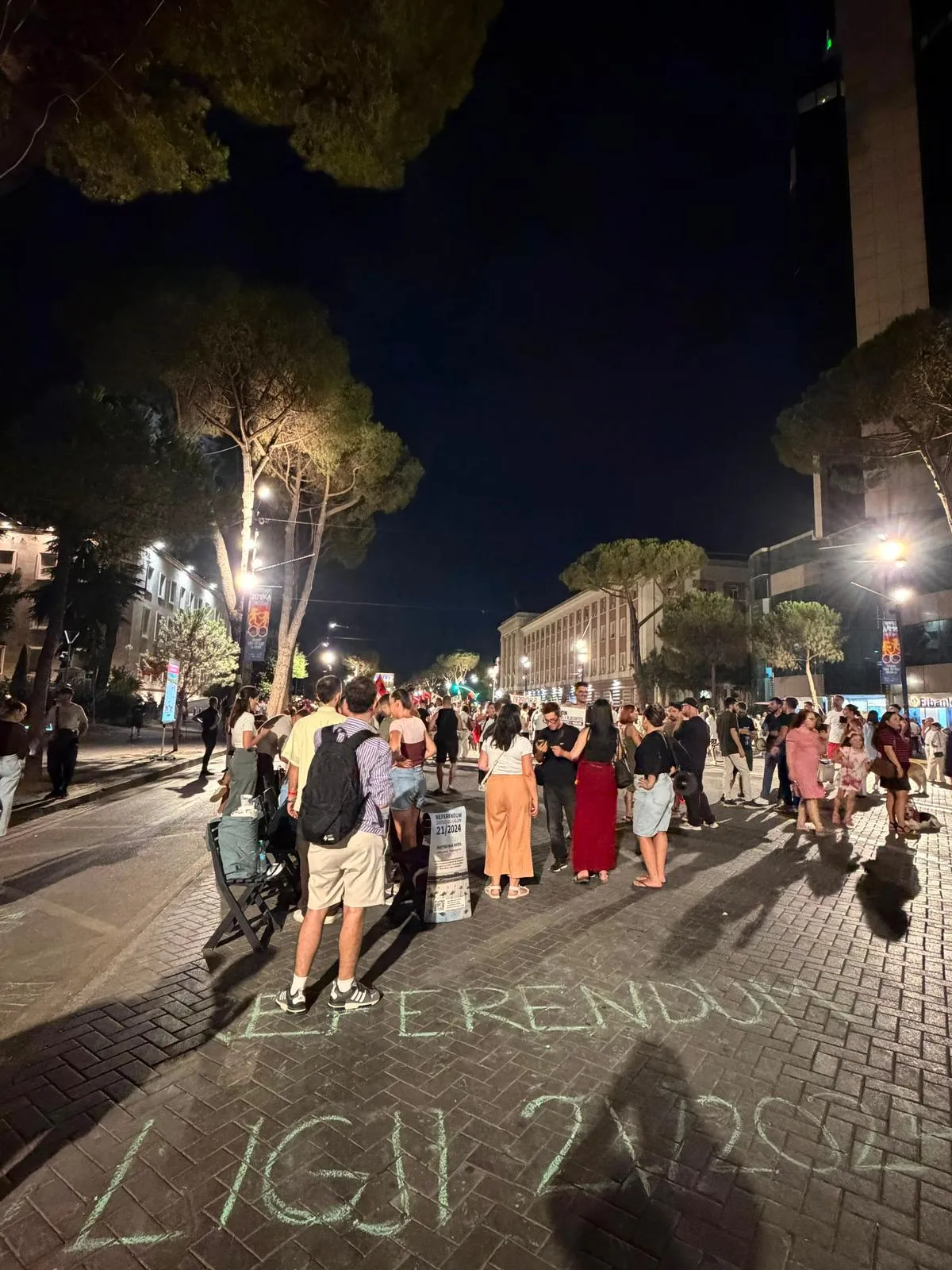
Citizen-led, non-partisan initiative files first formal step toward a national referendum on the law that opened protected coastline to luxury development.
The Albanian protest, known now as the Flamingo Revolution, that drew international headlines this summer over a luxury resort project linked to Jared Kushner has taken its fight to the ballot box. Twelve citizen initiators presented themselves at Albania’s Central Election Commission (CEC) a few days ago, filing the first formal step toward a national referendum on the repeal of Law No. 21/2024; the CEC has formally logged the request.
Passed in February 2024, Law No. 21/2024 struck out the article that had restricted construction inside protected areas and presented, in its place, the concept of ‘excellence tourism’: five-star-and-above accommodation now permitted inside national parks, alongside sweeping new authority for the Council of Ministers to redraw the boundaries and zoning of those areas. That single provision is what opened the legal path for the luxury resort development at Vjosë-Nartë linked to the American investor Jared Kushner — a project that, after months of construction without permits or environmental review, became the moment a country long accustomed to enduring in silence woke to injustice, igniting the daily demonstrations now known as the Flamingo Revolution.
The delta at the centre of the dispute, Vjosë-Nartë, was declared part of the Vjosa Valley UNESCO Biosphere Reserve in September 2025, a status the EU itself had supported. Its lagoons and pine forests shelter flamingos, Dalmatian pelicans, loggerhead sea turtles and the critically endangered Mediterranean monk seal — one of the last stretches of undisturbed river delta left anywhere on the Mediterranean coast.
The movement, described by international outlets as Albania’s largest since the fall of communism, quickly outgrew Vjosë-Nartë itself, becoming a broader call for accountability, transparency and political reform; the law on protected areas remains one of its foundations.
Members of the citizen initiator group explained why they chose to support the referendum:
“We have been protesting for more than three months to protect Vjosa-Narta from a destructive tourist resort, convinced that the damage to its natural ecosystem would be irreversible. None of this would have happened if the Law on Protected Areas had not been amended and rolled back. Every protected area in Albania’s network is under the same pressure as the Vjosa delta and will remain so until this law is repealed.”
— Besjana Guri, Founder of NGO LUMI; 2025 Goldman Environmental Prize Laureate for Europe
“We know, and the European Union has made clear, that Law No. 21/2024 is part of the problem, yet Parliament and our elected representatives have failed to act. Through this referendum, citizens are exercising their constitutional right to ensure that the future of our protected areas is decided by the Albanian people, not by political inertia or narrow interests.”
— Gëzim Shuli, Executive Director, Albnatyra
“After years of working in territorial management and sustainable development, we see Law No. 21/2024 as more than an environmental setback — it reflects a lack of vision for how Albania should develop. A country cannot put its territory at the service of one sector, while treating its natural capital as something to be consumed for short-term investment. Albania’s greatest advantage is not how much we can build, but what we still have to protect and build our future upon. This referendum is about choosing that future.”
— Oljam Dervishi, Founder & Executive Director of RESU NGO
The initiative is independent of any political party and puts one question to the electorate: should Law No. 21/2024 be repealed? There is a symmetry hard to miss: the law was passed on the initiative of 12 members of parliament; today, on the initiative of 12 citizens, they are seeking to place its future back in the hands of its people.
Albanians have not voted in a national referendum since 1998, the year the current Constitution — the instrument that now guarantees this initiative’s right to be heard — was itself submitted to the people for approval. Article 2 of that Constitution holds that sovereignty belongs to the people, exercised through elected representatives or directly; Article 150 gives that principle a concrete mechanism, entitling more than fifty thousand citizens with the right to vote to demand a referendum on the repeal of a law. Although other referendum initiatives are already under way — most notably separate campaigns for the repeal of the Law on Strategic Investments and the ‘Mountains Package’ — this effort is distinct in both its civic character and its subject. This initiative has been brought forward by an independent group of citizens, not affiliated with or directed by any political party, is supported by members of the Albanian diaspora through the Albanian Diaspora Civic Network (ADCN), and focuses directly on the protection of Albania’s natural heritage and protected areas.
Why the initiative has been brought forward
The concerns driving this initiative are neither new nor unsupported, but documented, including by the very institutions of the European Union that Albania is seeking to join. The European Commission’s 2025 Report on Albania, part of the annual enlargement package, found that nature protection had deteriorated since the amendments took effect, that environmental-impact assessment remained weak in practice, and that public participation in environmental decision-making had not improved over the year. The Commission tied these findings directly to Chapter 27 of Albania’s EU accession negotiations — the environment and climate chapter — whose closure the Albanian government has itself made conditional on addressing these amendments. Brussels, in other words, the partner Tirana most needs to persuade, already treats Law No. 21/2024 as part of the problem, not the solution.
Parliament has had opportunities to act since the protests began — and as European institutions have called for incompatible provisions to be reviewed and repealed — at least two legislative initiatives seeking to reverse the 2024 amendments have been submitted to the Assembly, but neither has yet reached the parliamentary agenda. Against that backdrop, the referendum has emerged as a way for citizens to move the question beyond parliamentary delay and into a direct democratic process.
For the initiators, the referendum therefore carries a significance beyond this particular law. It asks whether citizens should have to wait until environmental harm becomes irreversible before they can intervene, or whether the Constitution should be used as intended: to give the people a direct democratic means of acting while there is still something left to protect.
What happens next
With the request now logged by the CEC, next comes the official signature form, which will be made public once approved. After that, the group must secure the support of at least fifty thousand citizens with the right to vote — the threshold Article 150 of the Constitution sets — using only that form. Finally, the Constitutional Court will complete the preliminary review Article 152 requires within sixty days; if that review is favourable, the President of the Republic sets the referendum date by decree.
Roles and public information
The citizen initiator group is the formal applicant before the CEC and bears sole responsibility for the referendum request. The Albanian Diaspora Civic Network (ADCN), an independent, non-partisan network of Albanians abroad, supports the effort with research, public information, civic education, outreach and practical coordination. ADCN is not the applicant, does not direct the initiative, and does not stand in for the CEC or any other competent institution.
For more information, please visit the referendum landing page.
Media contact: team@albaniandiasporacivicnetwork.com. Supporting materials available on request.
Notes to editors
Albania has been a candidate for European Union membership since June 2014; accession negotiations formally opened in July 2022, and Albania has since opened all 33 negotiating chapters — more than any other current candidate. Chapter 27, covering environment and climate, remains open and is directly implicated in this dispute.
- ADCN team available for interview in English and Albanian. Contact via the details above to arrange.
- Photographs and video, including of the Vjosë-Nartë wetlands and the filing, are available on request.
- Background and prior international coverage of the protest movement are listed under Sources, below.
Sources
- Constitution of the Republic of Albania, Articles 2 and 150–152
- Electoral Code of the Republic of Albania, Article 185(2)
- Law No. 21/2024, amending Law No. 81/2017 “On Protected Areas”
- Law No. 81/2017, “On Protected Areas” (as updated)
- Constitutional Court Decision No. 45/2025, 31 July 2025
- CEC Regulatory Commission decision of 14 July 2026 on referendum-signature procedures
- European Commission, 2025 Report on Albania
- “Flamingo Revolution” — chronology and international reporting
- Mongabay — on the Vjosë-Nartë tourism project linked to Jared Kushner